Your Content Team Writes 60 Articles a Month. Your Competitors Need 1,000.
Innerly's AI SEO writer delivers 1,000+ monthly articles for fintech and crypto teams, trained on regulatory and blockchain terminology.


Let’s run the numbers on what a competitive content operation actually costs in fintech and crypto right now.
You need SEO content writers who understand blockchain terminology, can write about DeFi protocols without making errors that destroy credibility, and can navigate YMYL compliance requirements that Google applies to every financial article. In the US, an SEO content writer with crypto expertise costs approximately $84,000 per year in salary. A specialized crypto content writer with the technical depth to handle whitepapers and protocol documentation runs $74,000 to $100,000.
For a functional content team, you need at least four people: two writers producing 15 articles each per month, one editor handling quality control and regulatory review, and one SEO strategist managing keywords, clusters, and technical optimization. That’s $340,000 in annual salary before benefits, tools, office costs, and management overhead. Add 30% for total employment costs (benefits, payroll taxes, software subscriptions, training), and you’re at roughly $442,000 per year.
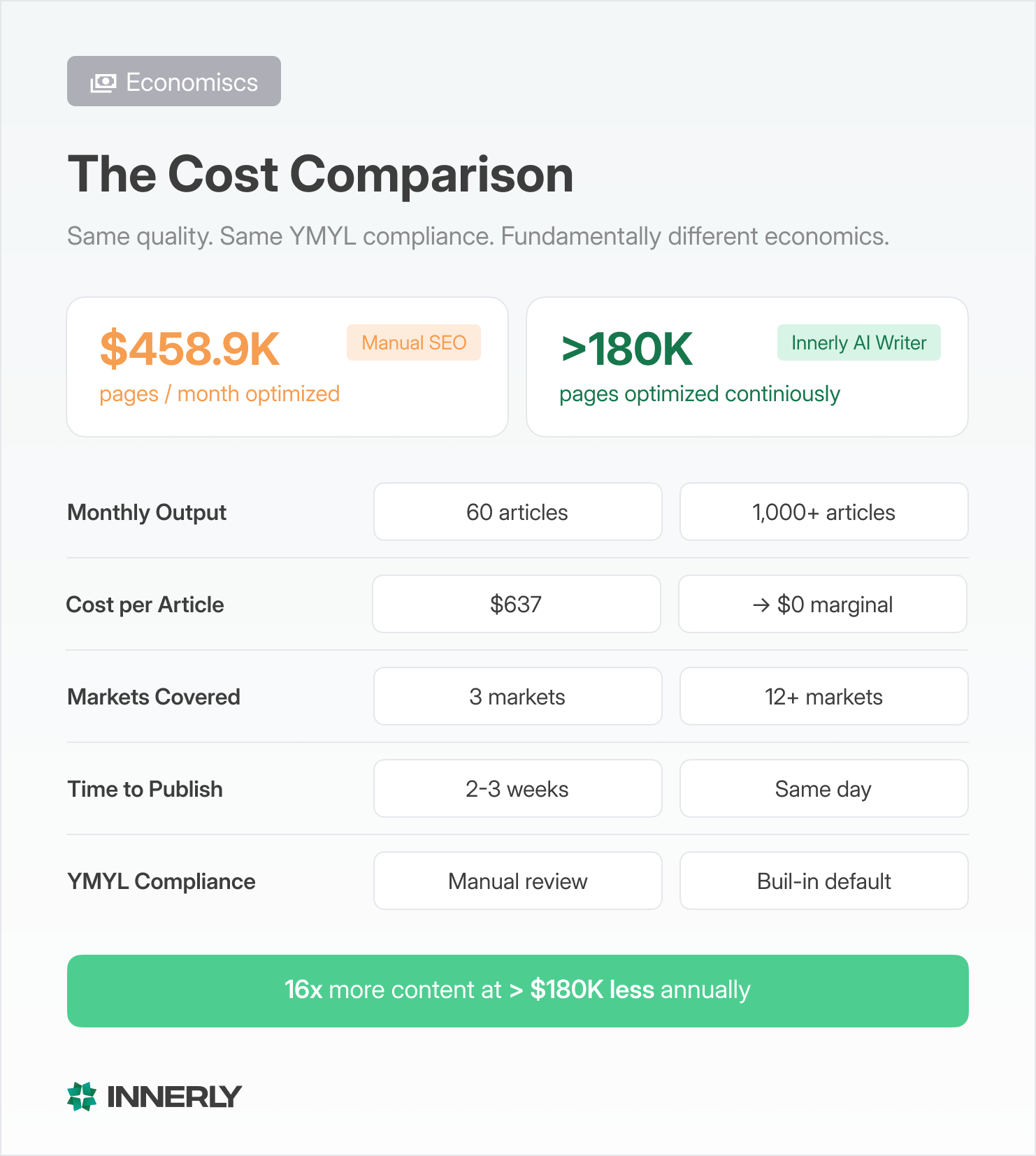
That team produces approximately 30 polished articles per month. If you push hard, maybe 60.
Now consider what the competitive landscape actually demands. A top-10 crypto exchange publishes content across 12 to 15 languages. Each language needs localized articles, not translated ones. A fintech platform expanding into Latin America, Southeast Asia, and Europe simultaneously needs market-specific content that reflects local regulatory environments, cultural context, and search behavior. The keyword universe in crypto alone encompasses hundreds of thousands of long-tail queries across trading pairs, DeFi strategies, regulatory updates, educational guides, and market analysis.
At 60 articles per month, it takes years to build meaningful topical authority across a single market. Across 12 markets? The math doesn’t work.
This is the content velocity problem. And it’s the reason the most aggressive crypto and fintech companies have moved from human-only content operations to AI-powered content systems that produce 1,000+ articles per month while maintaining the quality, accuracy, and compliance standards that YMYL financial content demands.
The Real Cost Comparison (With Math You Can Verify)
We’re going to break this down precisely, because “saves over $180K” is meaningless without showing the work.
Scenario A: In-house content team producing 60 articles/month across 3 markets.
Two SEO content writers (crypto/fintech expertise): $84,000 × 2 = $168,000. One editor with financial content experience: $95,000. One SEO strategist: $90,000. Total base salary: $353,000. Benefits, tools, and overhead (30%): $105,900. Annual all-in cost: $458,900. Output: ~60 articles/month = 720 articles/year. Cost per article: $637.
Scenario B: Innerly AI SEO Writer producing 1,000+ articles/month across 12 markets.
Annual platform and service cost: substantially less than Scenario A (exact pricing depends on engagement scope). Output: 1,000+ articles/month = 12,000+ articles/year. Cost per article: approaches zero marginal cost at scale.
The $180K+ savings is the conservative estimate for companies replacing or augmenting a Scenario A team with AI-powered content production. For companies that need to scale beyond 3 markets, the savings multiply. Adding a fourth market to Scenario A means hiring at least one more writer and increasing editor capacity. Adding a fourth market to Scenario B means updating a configuration.
That’s what “zero marginal cost per article at scale” actually means. The hundredth article costs the same as the thousandth. The English version costs the same as the Portuguese, Turkish, and Vietnamese versions combined.
Why Generic AI Writing Fails in Fintech and Crypto
Before addressing what makes this work, we need to address what doesn’t.
Generic AI writing tools (the ones that cost $49 to $299 per month) can produce content. They cannot produce financial content that meets YMYL standards, passes E-E-A-T scrutiny, and avoids the specific failure modes that get crypto and fintech content penalized or ignored.
Regulatory terminology errors. A generic AI tool doesn’t know the difference between how the GENIUS Act defines a “permitted payment stablecoin issuer” versus how MiCA classifies a “crypto-asset service provider.” It doesn’t know that writing “Bitcoin ETF” without specifying “spot Bitcoin ETF” versus “Bitcoin futures ETF” creates materially different content for compliance purposes. It doesn’t understand that describing a DeFi protocol as “guaranteed returns” triggers regulatory red flags that can damage both search rankings and legal standing.
Financial content demands a level of terminological precision that generic AI isn’t trained for. One wrong term in a regulatory article can make the entire piece unreliable in Google’s YMYL evaluation. One wrong characterization of a financial product can create compliance exposure for the publisher.
Hallucination in financial data. Generic AI tools hallucinate. This is a known limitation. In most content categories, hallucination is an inconvenience. In financial content, it’s a liability. An AI-generated article that states an incorrect APY for a lending protocol, cites a nonexistent regulatory ruling, or attributes a quote to the wrong executive creates content that actively harms trust signals.
Google’s quality raters are specifically trained to check financial claims against authoritative sources. AI engines like ChatGPT cross-reference claims before deciding to cite content. Content with factual errors doesn’t just fail to rank. It erodes the trust score of the entire domain.
YMYL compliance gaps. Generic AI writers don’t know what YMYL is. They don’t structure content to satisfy E-E-A-T requirements. They don’t include the sourcing, attribution, and credential signals that Google demands from financial publishers. They produce content that looks like financial writing but lacks the trust architecture that makes financial content perform.
The result is predictable: companies that use generic AI tools for financial content see short-term output increases followed by medium-term ranking declines as Google’s systems identify the content as low-trust YMYL material.
What a Purpose-Built AI SEO Writer Actually Does
Innerly’s AI SEO writer isn’t a general-purpose text generator with a crypto glossary bolted on. It’s a content production system designed specifically for the constraints, requirements, and competitive dynamics of fintech and crypto.
Trained on regulatory frameworks. The system understands the GENIUS Act, MiCA, PSD3, and major jurisdictional regulatory frameworks. It knows which terms carry legal weight, which claims require sourcing, and which characterizations of financial products need qualification language. This isn’t static. Regulatory environments change constantly. The system updates its understanding as new guidance, rulings, and frameworks are published.
Keyword cluster intelligence. The system doesn’t produce articles in isolation. It operates from a keyword cluster architecture that maps the entire search landscape for a client’s vertical: primary terms, long-tail variations, related questions, competitor gaps, and emerging queries. Each article targets a specific cluster position, building topical authority systematically rather than producing disconnected content.
For a crypto exchange, this means articles that cover not just “what is staking” but the full intent spectrum: “how to stake ETH on [exchange],” “staking rewards comparison 2026,” “is staking safe,” “staking tax implications [country],” and dozens of related queries. Each article links to others in the cluster, creating the internal authority architecture that Google and AI engines reward.
YMYL compliance by default. Every article includes the structural elements that YMYL financial content requires: clear author attribution with credentials, transparent sourcing with links to primary authorities, appropriate qualification language for financial claims, structured data markup (Article, Author, FAQ schema), and disclaimers where regulatory context demands them.
This isn’t optional formatting. It’s built into the system’s output architecture. A generic AI tool produces text. This system produces YMYL-compliant content packages ready for publication.
Multi-market content production. The system produces localized content for multiple markets simultaneously. Not translated content. Localized content that reflects the regulatory environment, search behavior, cultural context, and competitive landscape of each specific market.
An article about stablecoin regulations for the US market references the GENIUS Act and FDIC implementation guidance. The same topic for the EU market references MiCA and ESMA guidelines. The Brazilian market version references CVM regulations and local stablecoin adoption patterns. Each version targets market-specific keywords in the local language and is optimized for the local search ecosystem.
This is how you go from 60 articles per month in 3 markets to 1,000+ articles per month across 12 markets without multiplying headcount.
The Content Funnel: TOFU, MOFU, BOFU at Scale
Volume alone doesn’t drive revenue. The system produces content across the full marketing funnel, with each tier optimized for its specific conversion function.
-
Top of funnel (TOFU): Educational and awareness content. “What is DeFi lending,” “how crypto staking works,” “neobank vs traditional bank comparison.” High volume, broad keywords, designed to capture search demand from users beginning their research journey. This tier builds topical authority and domain trust while introducing the brand to new audiences.
-
Middle of funnel (MOFU): Consideration and comparison content. “Best crypto exchanges for beginners 2026,” “Revolut vs Wise for international payments,” “[exchange] vs [competitor] fees comparison.” Lower volume, higher intent. These articles target users actively evaluating options. They require competitive accuracy, up-to-date pricing data, and the kind of balanced analysis that E-E-A-T guidelines demand from financial comparison content.
-
Bottom of funnel (BOFU): Decision and conversion content. “[Exchange] review 2026,” “how to open an account on [platform],” “[product] tutorial.” Lowest volume, highest conversion value. These articles serve users who have already decided to act and need the final information to complete their decision. They require precise product knowledge, current feature sets, and step-by-step accuracy.
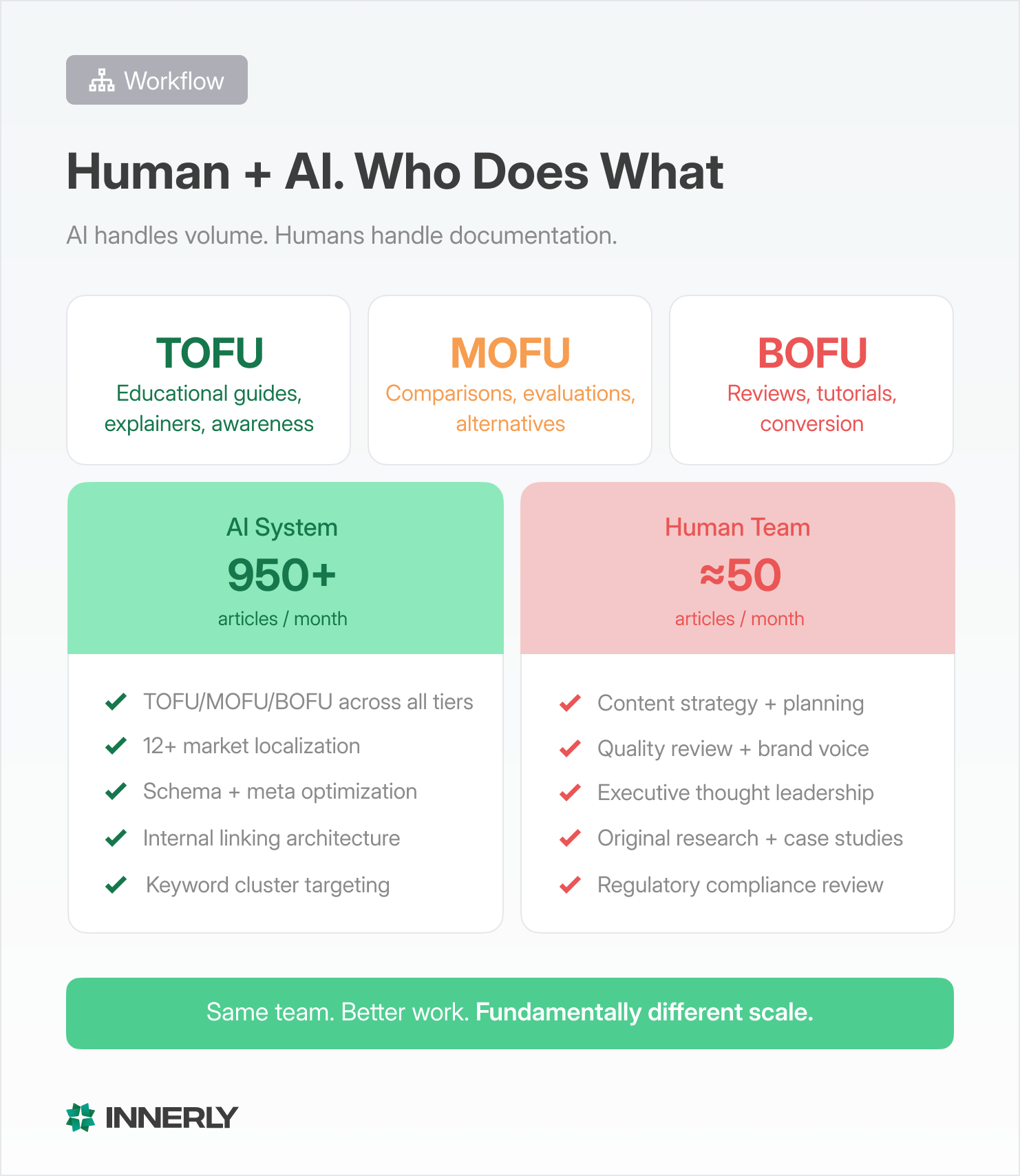
The AI SEO writer produces all three tiers simultaneously, maintaining the keyword cluster relationships between them. A TOFU article about staking links to a MOFU comparison of staking platforms, which links to a BOFU review of the client’s specific staking product. The internal linking architecture is built into the content production process, not added retroactively.
What This Means for Your Team
AI content production doesn’t eliminate the need for human expertise. It transforms what human expertise gets applied to.
Without AI content production, your writers spend 80% of their time on execution: drafting, formatting, optimizing meta tags, implementing schema, building internal links. They spend 20% on strategy, quality review, and creative work.
With AI content production, that ratio inverts. Your writers become editors, strategists, and quality controllers. They review AI-generated content for accuracy and brand voice. They develop the content strategy that guides the AI system. They produce the high-touch, differentiated content (original research, executive thought leadership, case studies) that AI can’t replicate.
The result isn’t fewer people doing more work. It’s the same people doing better work, at a fundamentally different scale. Your editors focus on the 50 articles per month that need human touch. The AI system handles the other 950.